
Twit-Twoo 🦉
The Owls Are Calling

Twit-Twoo
There I was: a balding middle-aged man in a big orange coat making hoo-hoo train noises as loudly as I could in a public park at night — only somewhat legitimised to bewildered joggers by the nine other people listening to this middle-aged man making hoo-hoo train noises as loudly as he could — all in the vain hope of attracting an owl.
After a few minutes, I turned away: ‘Well that didn’t work,’ I said. ‘Good thing I enjoy embarrassing myself in public.’ Everyone laughed politely.
And then...
Happy Belated Spring Equinox, Night Owls 🦉
For those of you new around these parts, welcome 👋 My name is David and I’m an outdoor instructor, Expeditions Manager at British Exploring Society, and Advanced Wilderness Therapeutic Guide (in training).
In 2026, every edition of this newsletter will give you one nature-based practice you can use right now to develop a deeper connection with yourself, with others, and with the world around you. 🌱
On Friday evening, in celebration of the spring equinox, I led my third night walk of the year in Crystal Palace Park.
These longer, sunnier days in London meant that there were many more people enjoying twilight in the park than there had been in January.
Friends and lovers sitting on benches, watching the sun go down, staying longer than perhaps they intended to, all for the pleasure of nightfall in this peaceful corner of the metropolis.
As you walk from Crystal Palace bus station onto the park’s Italian terraces, you’ll meet two old birch trees standing sentinel on the hilltop, their lank tresses wafting in the gentle evening breeze.
I call these two birch ‘The Old Lovers’. In Celtic folklore, birch is a symbol of love and fertility as well as renewal and purification — the perfect tree for spring.
Between the two birches is a bench and on that bench were two friends listening to music, singing, laughing, shouting for the equinox.
As we walked deeper into the park we passed strollers, dogwalkers, runners, cyclists, and two teenage girls, one of them breathlessly reading aloud a message she’d got from some young suitor on her phone: ‘I’ve always admired you, your gorgeous hair…’
Spring is springing!
Horse Chestnut Fireworks
One of the most thrilling displays in our parks right now is the sight of horse chestnut candles blooming.
These flamboyant flowers are a slow-motion firework explosion and what’s fun is that you can often see the candles in different stages of inflorescence on the same tree.
In Crystal Palace Park, we’re lucky that three young horse chestnuts have been planted in a cluster in the English Landscape Garden near the rusty laptop (if you know, you know) so you can get a real eye-to-eye, royal box view.
You don’t want to miss it.
I recommend you go back daily: watching, waiting, anticipating…
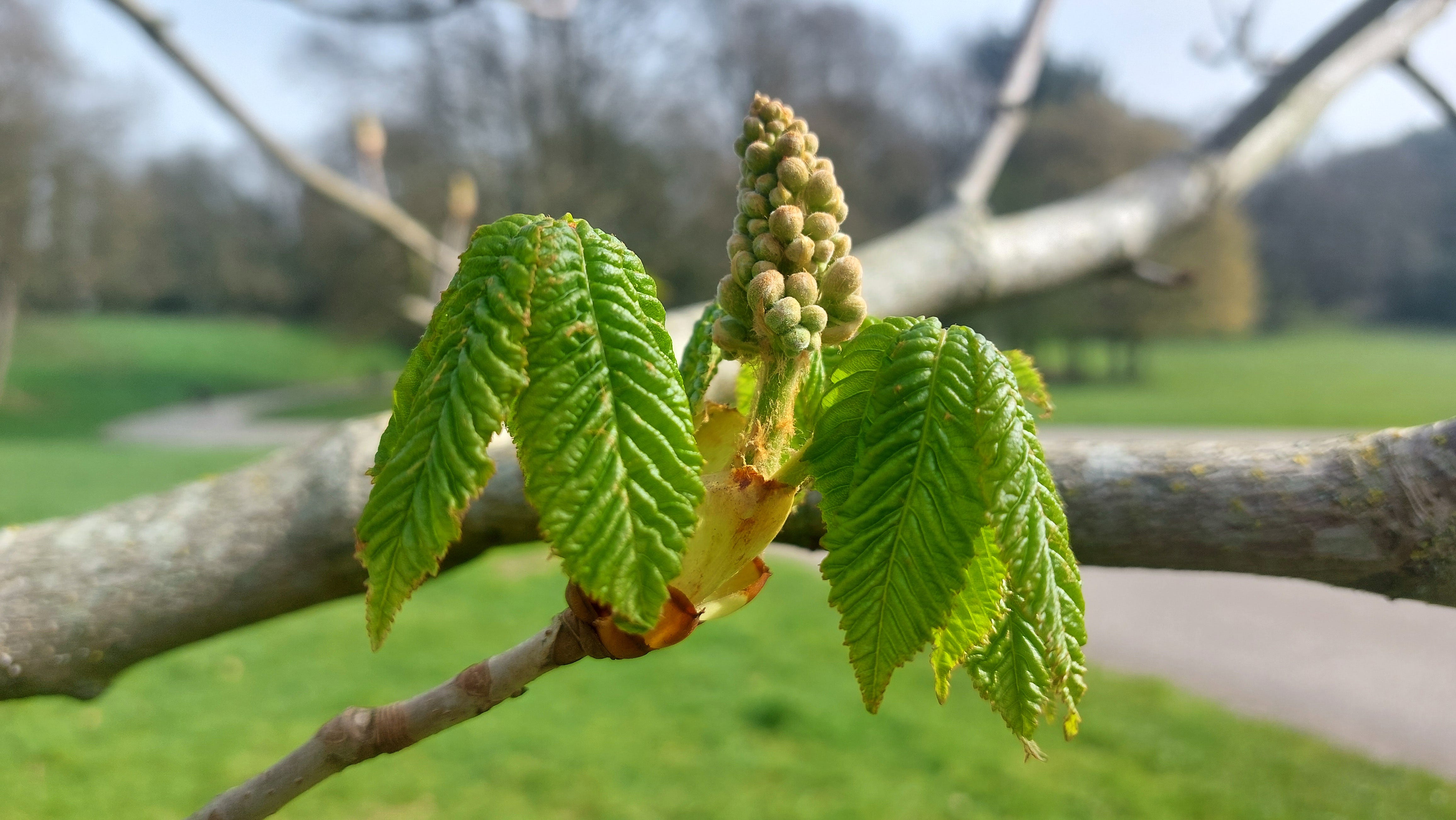
On Friday evening, I was just about to introduce this trio of horse chestnuts to our equinox night walkers when, faintly, we heard a hooting from afar.
We stopped and held our breath.
Way off, in the trees up by the reservoir, was a tawny owl. Its call not unlike a sort of ghost train.
We stood transfixed, a male calling for its mate. But the sound faded and we moved onto the chestnuts, grinning.
The night was clear and mild: we could see 715 million kilometres all the way to Jupiter and beyond, past Gemini and Orion, over a thousand light years away to Alnilam, the central buckle on Orion’s Belt, a star 28 times more massive than our sun.
With over 3,500 trees, Crystal Palace Park is a forest and, together in the growing dark, we marvelled in awe at some of my favourite trees — the grove of Yew, the Cork Oak, the Cedars of Lebanon and the Giant Sequoia.
It’d already been a marvellous walk, but walking back up the hill towards the trees where we’d heard the owl calling, I couldn’t resist to call back with my owl whistle.
And so there I was: a balding middle-aged man in a big orange coat making hoo-hoo train noises as loudly as I could in a public park at night, in the vain hope of attracting an owl.
As I turned away in defeat, we heard the faintest of replies — but it could easily have been traffic from the road. Then, as we laughed at my buffoonery — the owl was above us, calling right back.
Scarcely able to believe our luck, we went back and forth, he and I, between human and beyond-human. A hoo-hoo from me and a hoo-hoo from him. Until, finally, I couldn’t bear to keep him any longer and we walked back toward the lights of the city.
This Week’s Practice: Owl Calling
You don’t need to call for an owl yourself for this practice to work. Listening to owls calling each other is magic enough.
If you do decide to try calling for owls, then please don’t call for too long and don’t go to the same area too often. The male’s hoo-hoo is a territorial call and you might stress him out by calling back at him for too long.
Always let the owl win.
Preparation
OPTIONAL: Practice your best twoo-twoo calls, or buy a birch wood owl whistle — they really work!
Get to know your neighbourhood tawny owl on the RSPB website.
Practice
Find a promising broadleaved woodland nearby, one with mature trees. In the city, look for an old park, cemetery or garden.
There are around 50,000 pairs of tawny owls across England, Wales and Scotland (but not Ireland) and they stay together in the same area for life. Even in the city.
March is a great time to hear owls calling because it’s mating season and the males will be defending their territory from interloping young Romeos (or middle-aged men with whistles).
Time of day: early evening twilight and nightfall is perfect.
If after three or four nights you don’t hear owls in your woodland, then try somewhere else. Assuming you’ve got a decent ear and you stay quiet, at this time of year you’re almost guaranteed to hear an owl if there’s one floating about.
Why This Practice Works (the science bit)
Interactions with birdlife, including owls, are linked to lasting improvements in mental health and wellbeing, even among individuals with depression, by fostering positive emotions and reducing anxiety (Hammoud et al., 2022; White et al., 2023).
These benefits arise from multi-sensory engagement with wildlife, including human-animal interactions like owl calling, that enhance our restorative experience of an environment and deepen nature connectedness (Zhang et al., 2025; Yerbury & Lukey, 2021).
Human-animal interactions can also promote feelings of love, belonging, fulfillment and perspective on our lives, all of which contribute to psychological wellbeing and encourage caring for nature (Yerbury & Lukey, 2021).
Positive human-owl coexistence in urban or woodland settings can foster meaningful relationships with wildlife that benefit both human and owl (Parker et al., 2025).
Let me know how you get on!
Upcoming Night Walks + Whatsapp Group
Many thanks to Crystal Palace Park Trust for commissioning this spring equinox walk, funded by the National Lottery — yes, my first paid night walk!
If you would like to join our next London night walk, please reply to this email or join the Whatsapp info group by clicking here.
I have already submitted a proposal for a longer series of night walks in the summer evenings. Later in the year I shall also be running Night Shift Journey, where you can join me on a dusk-to-dawn therapeutic night walk through the New Forest.
Reply to this email to get on my informal early bird / night owl list for personalised notifications as these bigger, scarier events bud and blossom. 🦉
Thank You
Huge thanks to all the paying subscribers who helped make this newsletter possible. You know who you are. Thank you. 💚
If you enjoyed this one, then go ahead and tell me. It’s the only way I’ll know. You can tap the heart button, write a comment, share the newsletter with friends, or simply reply to this email.
If you’re not into the whole Substack subscription thing, then you can also make a one-off, choose-your-own-contribution via PayPal. That’d make my day.
As always, thank you for your eyeballs and thanks for your support.
diwyc,
dc: