
This Emotion Kills Fascists
Awesome Attenborough and a foxglove in the forest

Summer Series: Episode Awe
We stood still for a moment.
And there it was again: the churring, two stroke engine of the nightjar, coming from here, there and everywhere in the gorse around us.
We waited and then — there! He broke cover, inquisitive, flying around and around us in circles, angel wings against the disappearing horizon.
Eager readers of this journal might remember my dusk to dawn walk last year, my first encounter with the nightjar, and a parting gift from the forest in the form of a personal mantra:
Last Thursday night1, I did the walk again — or rather we did it again. This time, I night walked with a friend.
Over a week later, I remember precious moments from the night: the crescent moon hanging in a pool of water, a frog kicking through a forest stream, tawny owlets begging for food in a grove of ancient yew, song thrushes singing joy in the misty haze of dawn — and of course the nightjars.
But perhaps the most profound moment happened inside half an hour.
We’d just walked up through Franchises Wood, dumped our packs on the side of the trail, and settled down on mossy roots to watch the last of the sunlight filter through the beech trees.
Sunlight through beech leaves is one of my favourite experiences: the magic never fades once I’ve noticed it. But this was something new.
I leant back and stared upwards, basking in the gold green glow. My eyes were drawn to a single leaf, high above me, that stood out against the indigo sunset.
That’s me, I thought.
I expanded my gaze and took in the whole beech, with its tens or hundreds of thousands of unique but identical leaves — and only one of them, high up there, was ‘me’.
I broadened my perspective again, trying to encompass the dozens, hundreds of beech in this woodland, each with their own many thousands of leaves, all the same but different to the one I called ‘me’.
I narrowed my gaze again to ‘me’. I expanded. I narrowed. I expanded. I laughed with joy.
No — not joy. Something else.
Welcome to the fourth episode of my Summer series.
So far this summer, we have explored three of our primary senses: Sight, Touch and Smell.
We’ve gazed at bees, touched wood and planted lavender. We’ve (not) seen invisible colours, felt the difference of 10 nanometres and got smells into our bloodstream.
Today, we’re going beyond these everyday experiences.
We’re exploring our innate capacity to perceive and respond to vastness and mystery that takes us way outside our ordinary frames of reference.
It’s the same emotion I felt gazing up at the beech leaves.
Awe.
OMG: This Emotion Kills Fascists
Okay, so ‘kills fascists’ is rhetorical, but bear with me.
Fascism thrives by shrinking our moral circle — dividing the world into them and us, elevating our petty tribe while dehumanising everyone else.
Awe does the complete opposite.
Gazing up at the stars.
Singing in a choir.
Looking at your hand through a microscope.
Holding a newborn.
Watching Messi play football.
Experiences of awe can make us feel tiny and insignificant in relation to the vastness of the universe.
In that moment, and sometimes for a long while after, our ego quietens down and we feel a smaller sense of self.
That shift to a ‘small-self’ mindset has been shown to help us expand our moral circle, to make us care for a much wider tribe of human and non-human beings, strangers and foreigners, animals and plants.
Where fascists see threat, awe shows us connection.
Your Turn: Awesome Attenborough
Awe is available to us everywhere and any time. But we don’t often bump into by accident as we’re going about our daily lives.
(Unless you are a baby. I like to think that awe is the default experience of babies.)
Of course I’m going to say that a dusk-to-dawn night walk through a forest is a phenomenal way to increase your chances of bumping into awe.
Phenomenal, but not at all necessary.
So we’ll start with the exact same method scientists use to elicit awe in the laboratory.
Five minutes of David Attenborough’s Planet Earth. Put it on the big screen. Pump up the volume. Dim the lights. Hit play.
How Does It Work? (The Sciencey Bit)
Awe happens when we feel connected to something much greater than ourselves — so much so that we need to revise our ordinary mental models of our place in the cosmos.
If you’re thinking, ‘That’s a bit of a stretch for a Youtube video,’ then you might be right.
The studies of Song et al. (2023) found only an indirect effect of awesome videos on moral expansiveness.
Participants came away with a significantly wider moral circle only insofar as they said the video was awesome.
If they found the video super duper awesome, then Song et al. found that they were also likely to feel a sense of ‘vastness vis-a-vis the self’ — and that is what predicted a broader moral circle.
If they didn’t dig the vid, no dice.
But Song et al. did one experiment using virtual reality.
Floating above the virtual planet Earth from virtual space was a mindblowingly awesome experience for most people and, lo and behold, Song et al. found a direct effect — participants who took the VR flight came out with a significantly wider moral circle than those who didn’t.
But even here, Song et al. discovered that the increase operated through the same psychological mechanism as the videos: the VR experience almost guaranteed a sense of ‘vastness vis-a-vis the self’ and, again, that’s what expanded the participants’ moral circle.
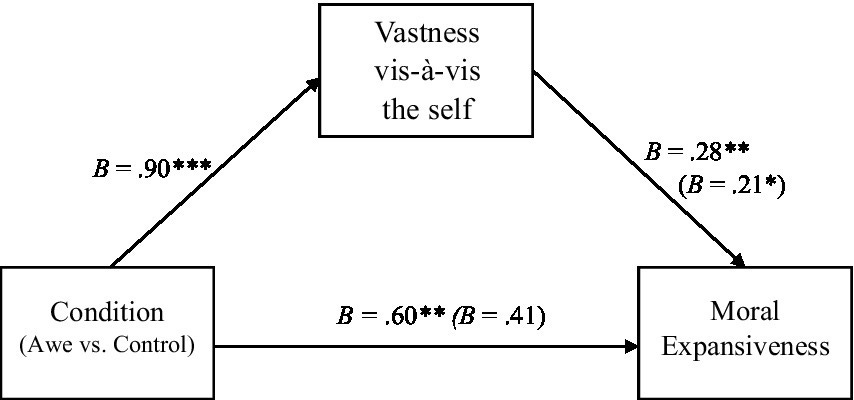
Awe makes us feel part of something larger than ourselves. The more we feel connected to the universe, the more we care about the beings in that universe.
The more awesome the experience, the more reliable the effect.
Virtual Reality worked better than Attenborough. And you know what’s better than virtual reality?
Reality reality.
For me: a night walk through the forest.
And for you?
Go Deeper
Huge thanks to all the paying subscribers who helped make this newsletter possible. You know who you are. Thank you. 💚
If you enjoyed today’s story, then go ahead and tell me. It’s the only way I’ll know. You can tap the heart button, write a comment, share the newsletter with friends, or simply reply to this email.
If you want to go deeper, I am in the process of putting together an 8-session therapeutic nature connection programme that will run in September and October in Southeast London.
Reply if you’d like to hear more.
‘A special and unique way to experience nature in London.’ – Julie
diwyc,
dc
Time flies. I wrote most of this over the solstice weekend, but didn’t finish it until today, two weeks later.