
Not Everything Needs to Grow Right Now
What the London Plane can teach us about our growing season

Happy New Year and a warm welcome from the Palace.
For those of you new around these parts, welcome 👋 My name is David and I’m an outdoor instructor, Expeditions Manager at British Exploring Society, and Advanced Wilderness Therapeutic Guide (in training).
In 2026, every edition of this newsletter will give you another nature-based practice you can use right now to develop a deeper connection with yourself, with others, and with the world around you. 🌱
City Night Walking
A week ago today, a group of ten hardy souls braved the frozen air to join me on our first city night walk of the year, through one of London’s most beautiful and mysterious city parks: Crystal Palace Park.
We met at the Vicar’s Oak two hours after sunset and, after explaining why I believe nightime to be London’s most restorative time of day, we stepped into the park, crossing the threshold between straight lines and fractals, bright lights and shadows, cacophany and silence.
A night walk through a city park is proof that, even in the busiest metropolis, it is still possible — easy, even — to find moments of calm, quiet and stillness in nature, and to feel, by connecting with the more-than-human, those same properties of calm, quiet and stillness as they ease into our weary bones.
Last week, I took the night walkers on a whistle stop tour of some of my favourite nature connection and therapeutic practises. These practices included:
Community of Oak
The View From Above
Tree Mentors
Fractal Silhouettes
Silent Night Walking
The Great Cedar of Lebanon
There are many more that I can’t wait to share with future night walkers and, in 2026, this newsletter is going to reach out and offer you a new way into nature connection that you can use wherever you live, even if you live in a hectic urban environment — especially if you live in a hectic urban environment.
This is just the beginning.
If you would like to join our next London night walk, please reply to this email and I’ll put you on the list.
Today’s Practice: Growing Seasons
Today I’m going to walk you through a great practice to start your year. I call it Growing Seasons.
You don’t have to do this — or any of my practises — at night. But if you feel comfortable to do so, the night can gently encourage deep therapeutic benefits.
Reduced sensory input, lower light levels, and quieter soundscapes naturally calm the nervous system.
The wild and mysterious virtues of darkness are not just poetic: they are physiological. Stillness, silence, and low light invite the body into rest-and-repair mode.
But no pressure: it works great in daylight too.
Find A Tree
During this practice you will be working with a tree. If you live somewhere without any trees, then find another being of living vegetation.
In my more psychedelic or sentimental moments, I truly believe that we can learn from every living being that we come across and even, through stories and imagination, from those we never meet.
So, in talking of living beings, I am speaking in the broadest possible sense. I’ve been known to do this practice alongside the lichen on a rock.
(In fact, there’s another practice I’ll introduce soon that will hopefully widen your interpretation of ‘living being’, perhaps more broadly than you might imagine.)
But for now we will assume you’ve found a tree.
Unmistakeably Alive
Trees are, I think we can all agree, unmistakably alive.
They respire, communicate chemically, share resources through underground fungal networks, and respond to stress with remarkable sensitivity.
They are also recognisably individual: each tree shaped by wind, soil, light, pruning, disease, and time. Instinctively reading meaning into form, it’s quite natural for us to project character, even a personality, onto our favourite trees.
Perhaps there’s a grandfatherly oak at the end of your street, storing centuries of carbon and memory. Perhaps your local churchyard is guarded by dark yew trees: ancient, toxic and ominously evergreen. Or perhaps an optimistic town planner once planted flamboyant palm trees in a vain attempt to add the flair of exoticism to a multi-storey carpark.
For this exercise, though, I want you to find a tree that to you looks utterly dead.
London Plane: Dormancy Is A Choice
Writing as I am from London, I’m currently standing beneath a London Plane, the iconic species of this city.
The London Plane is a resilient hybrid species, popularly planted in cities since the mid-seventeenth century, one of our most efficient urban airconditioning trees.
Its bark peels away in patches like military camouflage, shedding pollutants with its old layers. Its enormous maple-type leaves are the city’s lungs in summer. Its seed balls hang like baudy baubles in autumn.
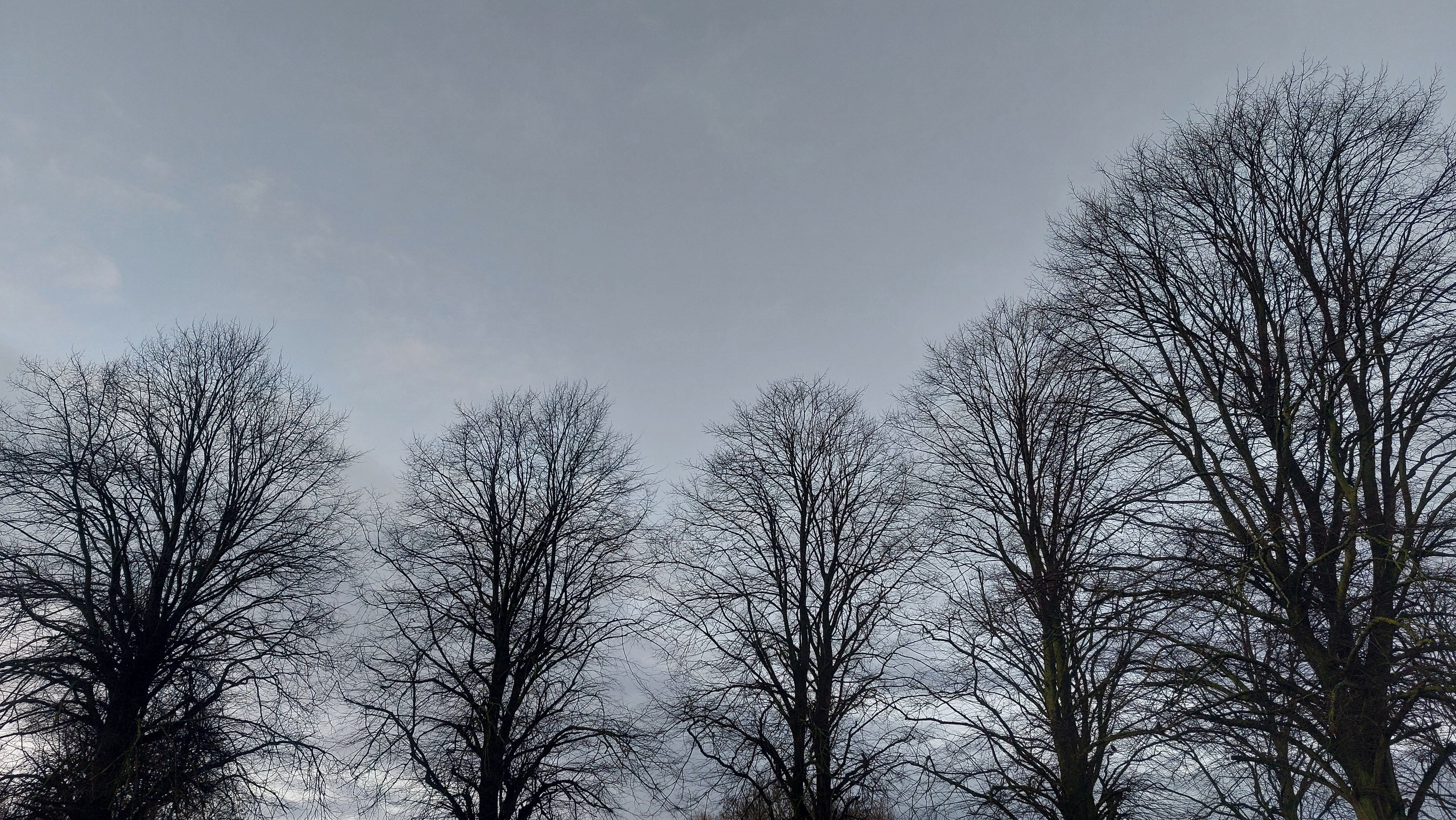
But now, in winter, it looks dead in the ground.
There are no leaves in its branches, no balls on their stalks, and even the bark looks necrotic, sodden from the rain. There are no buds, no young shoots. This particular specimen doesn’t wear any green coat of moss nor any puckerish sprout of intrepid fungi.
So come and settle down with me next to your chosen dead tree.
I’d encourage you to lean up against the bark, maybe make contact with the palm of your hand.
If it feels safe, close your eyes for a moment — not to imagine life in this tree, but to recognise it.
Because you already know: this tree is not dead. It is dormant.
Its bare branches are a choice.
Our Strategic Retreat
Deciduous trees like the London Plane don’t lose their leaves because they are failing. They drop them because they are adapting.
Leaves are expensive. They lose water, are vulnerable to frost, and require energy to maintain. As daylight shortens and temperatures fall, trees withdraw nutrients from their leaves, seal them off at the stem, and let them fall.
This is not decay — it’s strategic retreat.
Photosynthesis has become inefficient. The sun no longer provides enough energy to justify growth. So the tree shifts its priorities: conserving carbohydrates in roots and trunk, slowing metabolism, protecting vital tissues, and waiting.
Winter is not a growing season for the London Plane. Winter is for stock-taking, budgeting and decisive adaptation. Gathering together, strategic retreat, to prepare for the growing season ahead.
And this is what I want you to sit with this week.
What Is Best Left Until Your Growing Season Returns?
Connect with the wisdom of the dormant tree and ask yourself:
Where would I be wise to hibernate?
Where in my life am I no longer receiving enough energy to justify growth?
What is best left until the growing season returns?
Sometimes projects and relationships end. But sometimes they behave more like the London Plane, the oak, the ash, apple, or hornbeam. They don’t die — they pause. They maintain themselves at a sustainable level, waiting for better conditions.
And the leaf-dropping deciduous trees teach us that this isn’t failure. It’s intelligence.
If the turning of the year has raised questions about whether you should cut loose, quit, or walk away, I’d gently invite you to explore the idea of dormancy before destruction.
Perhaps something in your life needs to die back, to shed leaves, or even lose a branch or two for the health of the whole organism.
Perhaps it’s time to name, to others and to yourself, that you’re conserving energy. You’re not quitting, you’re resting. Growth will return when conditions support it.
And if you’re exhausted this winter because you’re trying to keep too many things in endless summer — you’ve got too many projects fruiting, too many relationships demanding full leaf — then listen to the deeper lesson the wintering trees offer us.
Endless growth is not nature’s default.
Conserve yourself. Even the mighty beech forest that frocks southern England from west to east relies on long seasons of rest.
Nature’s Twist
If this doesn’t quite resonate with you today, here’s the twist. Nature never solves a problem in only one way.
If you have an inkling that this winter actually is your season for growth — that there is quiet, fertile work to be done in the darkness while others rest — then you are right.
Perhaps the tree you connect with this season is the evergreen.
Conifers don’t abandon their needles; they armour them. On bright winter days, photosynthesis trickle-charges pine, spruce and fir even in sub-zero temperatures. Coniferous roots grow slowly, steadily, through winter’s cold soil, quietly at work while others choose hibernation.
There’s wisdom there too — everywhere you look.
If you would like to join our next London night walk, please reply to this email and I’ll put you on the list.
Thank You
Huge thanks to all the paying subscribers who helped make this story possible. You know who you are. Thank you. 💚
If you enjoyed this one, then go ahead and tell me. It’s the only way I’ll know. You can tap the heart button, write a comment, share the newsletter with friends, or simply reply to this email.
If you’re not into the whole Substack subscription thing, then you can also make a one-off, choose-your-own-contribution via PayPal. That’d make my day.
As always, thank you for your eyeballs and thanks for your support.
diwyc,
dc:
The deciduous vs evergreen comparison is what makes this framework really work. I've been trying to figure out whether a project I'm involved in needs to end or just go dormant, and framing it as "conserving energy until conditions support growth" changes the whole conversation. The part about endless growth not being nature's default was something I needed to hear, becuase capitalism has conditioned most of us to see any pause as regression. Had a friend once compare himself to an evergreen when everyone around him was hibernating, which caused him to burn out, so now I see both strategies as valid rather than one being "right."