
Do I Need My Big Coat?
This Week: Find Your Umbrella Tree

Happy Imbolc and the coming of Spring!
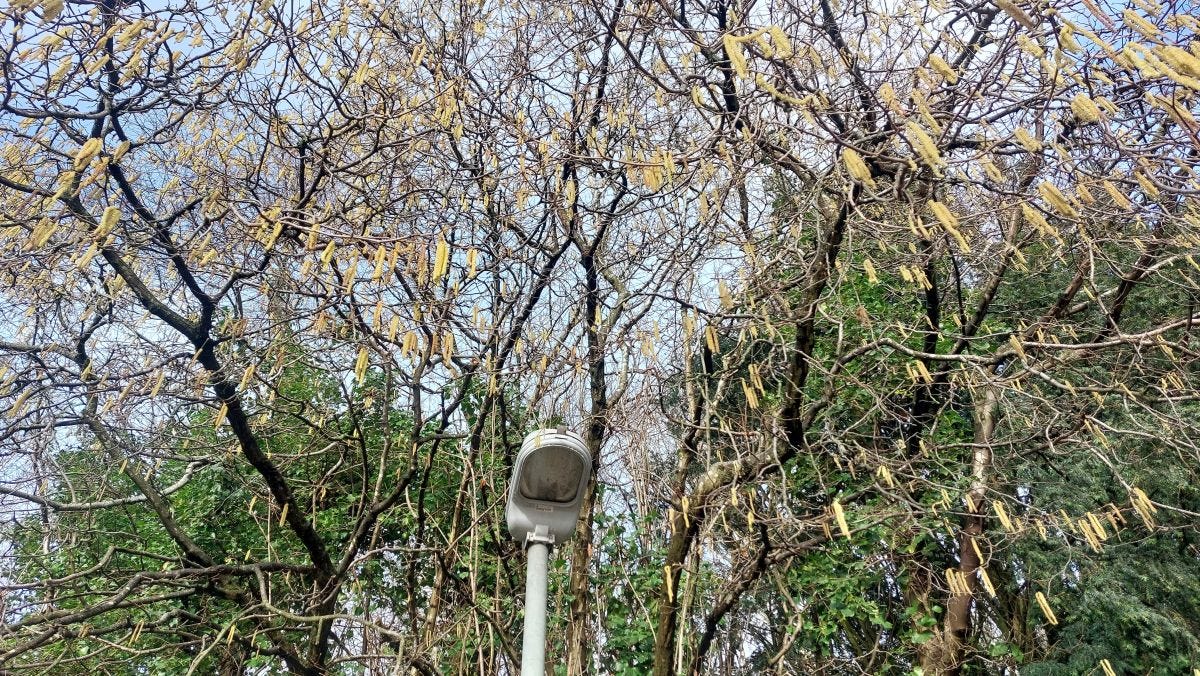
One of my bugbears is the popular insistence that the UK has four neat and tidy seasons of three neat and tidy months each.
We don’t. Especially not in the south, and especially not with rising temperatures playing merry havoc with our biosphere.
Both astronomers and meteorologists follow the 4x3 rule, but disagree on where the seasons divide.
Astronomers follow the eternal rhythm of solstice and equinox, meteorologists follow the rhythms of climate. Both bow to the inevitable diktats of data science.
But most of us are neither astronomers nor meteorologists — and certainly not data scientists. We are humans. We measure seasons by how our world looks and feels.
Are there leaves on the trees? Wildflowers in the understorey? Birdsong on the air?
Is it still light when I cycle home from work?
Do I need my big coat?
In England, Spring is on average two degrees warmer than it was in 1970. This has had a significant knock-on effect on how ‘Spring’ looks and feels in this country.
So it’s time we updated our seasonal definitions.
Behold, then, what I will call The Optimist’s Calendar:
Spring begins when you first spot crocuses, daffodils, catkins or any other signs of life in our hitherto hibernating plantlife: usually sometime in mid to late January, but at the latest let’s say 1 February (Imbolc).
Summer begins when the clocks change to British Summer Time (clue’s in the name): the last Sunday in March.
Logically, then, Autumn begins when the clocks change back: the last Sunday in October. (This may sound late, but I’m happy as long as Autumn includes both Hallowe’en and Bonfire Night.)
Winter begins when you open the first door on your advent calendar: 1 December.
That gives us two months of Winter, two months of Spring, one month of Autumn, and a glorious seven months of Summer.
For those of you new around these parts, welcome 👋 My name is David and I’m an outdoor instructor, Expeditions Manager at British Exploring Society, and Advanced Wilderness Therapeutic Guide (in training).
In 2026, every edition of this newsletter will give you one nature-based practice you can use right now to develop a deeper connection with yourself, with others, and with the world around you. 🌱
Find Your Umbrella Tree
Last Friday, I led our second Night Walk around the gorgeous forest of Crystal Palace Park. (If over 2,500 trees doesn’t make a forest, then I don’t know what does.)
The weather was almost comically bad: a bright day growing overcast in the afternoon, with the first spots of a certifiable downpour falling as I stepped outside at 6pm.
It rained steadily for the whole of our walk. And stopped as we crossed the threshold home. Soon after, the stars were out.
Credit to those who came; no shade at all on those who postponed.
Three Good Reasons It’s Even More Important You Go Outside To Play In Crappy Weather
If you’re reading this, you’re probably already convinced of the positive effects of spending time in nature.
Not surprisingly, however, most of us feel at least a little disinclined when we hear the first spots of rain on the windowpane or see oily puddles forming on the pavement.
But scientists have done the studies. Nature works in all seasons.
The tragedy is that we humans both underestimate the benefits of inclement nature connection and overestimate our discomfort.
Deep down, you know this is true, right?
If you’ve got the right clothes — and you feel safe enough from lightning, high winds, tree fall, hurricanes and so forth — you will always feel better for the walk.
And, actually, there are at least three good reasons why going out in the rain is even more important for us than going out in the sunshine.
Winter has the crappiest weather and the least amount of sunshine. Our mood and immune systems are already at their lowest. Staying indoors will only exacerbate that. Go outside!
Rain stirs up an earthy chemical called geosmin. The detection of geosmin is one of our human superpowers: we can detect the equivalent of one microgram in a full bathtub. It’s (maybe) how our ancestors found water in the desert. Go outside!
The pitter-patter of rain on tree leaves is a gorgeous natural soundscape that has been shown to improve mood, restoration and cognition. GO. OUTSIDE.
Which brings me onto today’s nature connection practice.
This Week’s Practice: Find Your Umbrella Tree

One of the practices that we did last Friday was at the Umbrella Tree: an old Holm Oak that sits perfectly flanked by two pink sphinxes on the Italian Terraces of Crystal Palace Park.
The spreading canopy radiates around the trunk just like an umbrella and provides welcome respite for the bedraggled night walker — not only from the rain, but from the constant stimulation of modern life in the city.
This week, I encourage you to find your own Umbrella Tree.
Preparation
For this practice you will need to find a tree with a dense spreading canopy that you can stand beneath, sheltering you from the elements.
The best contenders are, clearly, those that do not drop their leaves in winter.
The Holm Oak is a splendid candidate — with bonus points for their low-hanging branches that allow a foothold for the intrepid treeclimber.
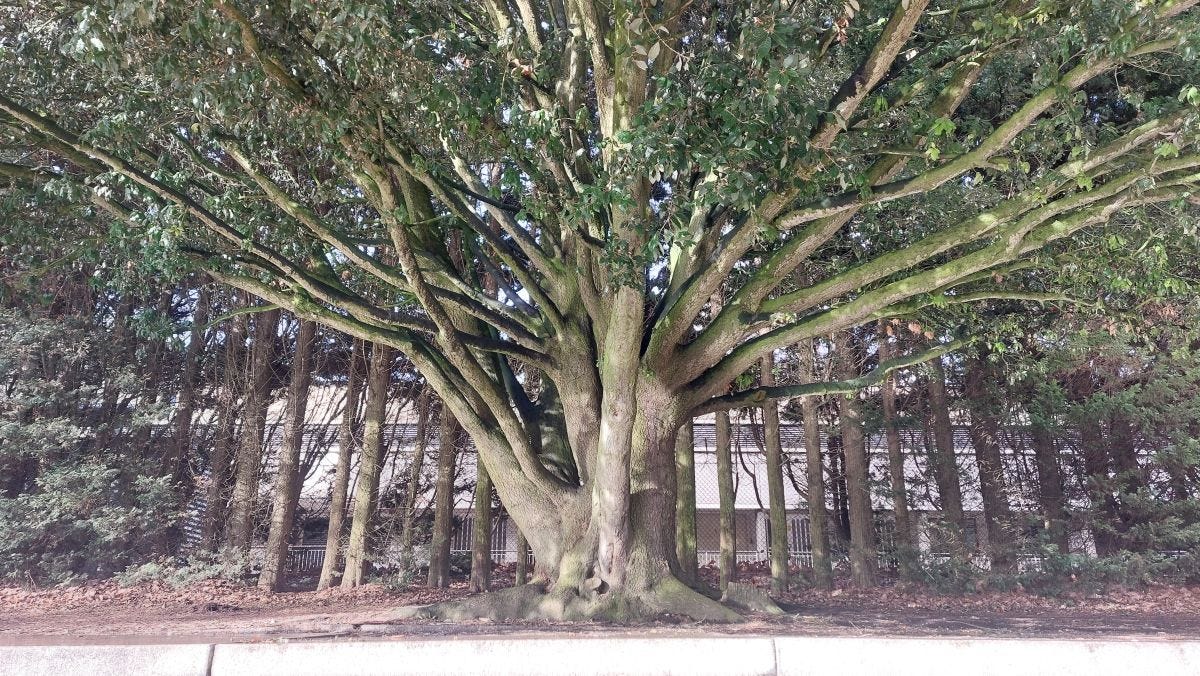
Other suitable trees include Yew, Holly, Laurels and Cedars. Even a well-proportioned bush will do the trick.
Pines are FINE, but tend to funnel the rain right down your neck.
⚠️ Please don’t panic if you’ve wandered around your local park for half an hour and still not found a suitable tree. You’ve already won: half an hour studying trees is more than enough to get all the juice of nature connection. Go home and have a brew.
Practice
Take a moment to make contact with your tree. You don’t have to do this practice at night, but the darkness does help you lean into your other senses. If you feel comfortable, you could close your eyes.
Lean back against the tree. Place a bare hand against the bark. Pressing your forehead — or even your face — gently against the tree can deepen the sense of contact (though passers-by may conclude you’re having a quiet existential episode).
Listen to the sound of the rain against the canopy. Notice how this natural, irregular ‘white noise’ softens your internal dialogue and settles your nervous system.
Breathe slowly. Inhale what the tree and the earth are offering. After rain, the air often carries geosmin, an earthy restorative scent produced by soil bacteria. Rub your hands gently against leaves or branches and notice their smell, their oils, their life.
If your eyes are open, look up and watch the dance of the leaves in the wind. Feel your brain shift into a relaxing, dreamy state of ‘soft fascination’.
Allow yourself to drift. You don’t need to do anything here. Simply let your attention rest, supported by bark, breath, sound and scent.
Why This Practice Works
Enclosure and nervous system regulation. Environments that create a sense of shelter and refuge are associated with parasympathetic (rest-and-digest) nervous system activation. This aligns with Attention Restoration Theory, which suggests that ‘softly fascinating’ natural environments require less mental bandwidth and increase our sense of restoration.
Tree contact and tactile grounding. Physical contact with natural surfaces can enhance interoceptive awareness and grounding, helping shift people out of threat-based states.
Sound of rain and leaves. Natural soundscapes like wind in leaves or rainfall can reduce amygdala activation and support emotional regulation more effectively than artificial noise.
Smell, geosmin, and volatile organic compounds. Soil inoculated with the geosmin‑producing bacterium Streptomyces rimosus increased serotonin, reduced inflammatory marker CRP, and increased alpha EEG activity during horticultural tasks, suggesting mood‑supporting and calming effects of soil VOCs, including geosmin.
Low light and sensory shift. Reduced light conditions naturally down-regulate visual dominance and encourage multisensory awareness, which enhances stress reduction, wellbeing and calming effects compared to visual-only stimulus.
Upcoming Night Walks + Whatsapp Info Group
Good news!
After the success of our first two City Night Walks, I am planning to do them on a more-or-less fortnightly basis right through to summer (see The Optimist’s Calendar above).
They will remain free to access, but you can always make a contribution through Substack or Paypal if you so desire (see below).
If you would like to join our next London night walk, please reply to this email or join the Whatsapp info group by clicking here.
As the evenings lengthen through Spring and into Summer, I will be adding a range of night walks, including longer sessions, new city parks, pre-dawn sitspots, and of course Night Shift Journey, where you can join me on a dusk-to-dawn therapeutic night walk through the New Forest.
Reply to this email to get on my informal early bird / night owl list for personalised notifications as these bigger, scarier events bud and blossom. 🦉
Thank You
Huge thanks to all the paying subscribers who helped make this newsletter possible. You know who you are. Thank you. 💚
If you enjoyed this one, then go ahead and tell me. It’s the only way I’ll know. You can tap the heart button, write a comment, share the newsletter with friends, or simply reply to this email.
If you’re not into the whole Substack subscription thing, then you can also make a one-off, choose-your-own-contribution via PayPal. That’d make my day.
As always, thank you for your eyeballs and thanks for your support.
diwyc,
dc: